FFCE

Now Hiring: Are you a driven and motivated 1st Line Food Technologist?

commercial food production

Transitioning a food product from kitchen production to commercial factory manufacturing
FFCE

Kitchen Recipe to Factory Setup — Role of a Food Consultant

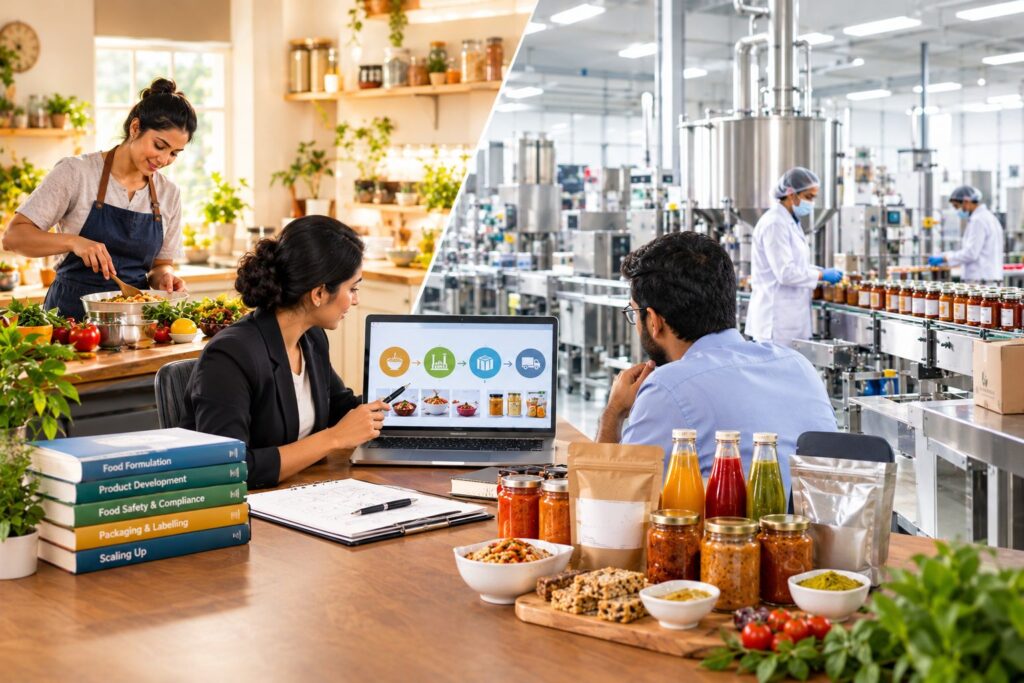
Expertise in product scaling, recipe standardization, and knowing how to develop an efficient plant layout are critical moves to take an incredibly good food recipe into a viable commercial product. A food consultant, works along with a food technologist to adapt a recipe for commercialization, ensuring replication at mass levels, maintaining its quality and the facility meets the regulations. Their expertise and guidance enable you to move from making food in the home kitchen to having a food brand ready! Introduction It is not an easy task to bring a popular kitchen recipe to a large-scale commercial operation. Even though the original concept may have come from tradition and passion, it takes a methodical approach to turn it into a marketable product. A food consultant can be a very useful partner in this situation. With the assistance of qualified food technologists, food consultants help aspiring business owners at every stage of their food enterprise journey, from product scaling to plant setup and regulatory compliance. Products developed 0 + Years experience 0 + Countries served 0 + Clients served 0 + The First Step: Recipe to Scalable Product Large-scale production is not possible for everything that functions well at home. A recipe designed for five servings may not function the same way when multiplied by five thousand. Product scaling enters the picture here. To keep the original flavors, textures, and appearances of a recipe but adapt it to commercial levels of production, a food consultant works in coordination with a food technologist. It is important to know how the ingredients will act in terms of shelf life, microbial safey, package intent, and cooking methods before product scaling up the best practices. If a recipe called for a spice blend, for example, the spice blend could also need to be reformulated too, if it has an adverse response to industrial heating or preservation methods. The expertise of food technologists allows for this harmony between science and culinary art. Product Standardization & Shelf-Life Testing Standardization is a crucial next step after product scaling. Consistency is the most crucial element in the food industry. All units must be identical in flavor, aroma, and appearance. The food technologist will test for shelf life and stability of the food products and the food consultant will make sure each production of the product conforms to established standards. This scientific testing will guarantee food safety and appeal to the consumer, but it will also help to determine the best packaging material and additives (if required), and storage conditions. Plant Setup Designing the Right Infrastructure A proper plant setup is necessary for the transition from a test kitchen to a commercial kitchen. Plant setup entails figuring out workflow design, utilities, hygienic zones, equipment needs, production capacity, and even employee training. A food consultant assists in creating a layout that facilitates efficient operations, conforms to food safety laws, and permits future growth. The food consultant evaluates 1.Type of food product 2.Required machinery 3.Water and energy needs 4.Waste management system 5.Clean room and contamination control areas. Depending on the type of product, each plant setup has a unique design. For instance, the equipment and layout of a bakery will differ from that of a sauce or beverage processing facility. Compliance and Licensing Support Adhering to legal compliance for food safety and getting licenses such as that given by the FSSAI in India is yet another requirement for plant setup. Food consultants assist clients with documentation, auditing, and certification. A food consultant also determines whether clients’ food and drinks manufacturing plants conform to the required industry standards (like Good Manufacturing Practices (GMP) and Hazard Analysis and Critical Control Points (HACCP)). Production Trials and Commercial Launch Food consultants manage pilot batch trials ahead of commercial production runs. Doing so improves efficiency, provides evaluations for the yield and quality of the production lines, and highlights issues for bottlenecking. Also, this is where we fix anything that isn’t working with the formulations, packaging, and flow of process. Once process validation is complete and the product is prepared for commercial release, the food consultants often provide continuing advice, to help resolve production issues and optimize costs without the sacrifice of quality. Conclusion Scaling a recipe from kitchen to market is much more than just passion, it takes technical knowledge. With the right support with respect to product scaling, formulation and plant set-up, entrepreneurs can ensure consistent quality and meet regulatory compliance. With the help of a food consultant, knowledge of a food technologist, and a thoughtfully constructed facility, entrepreneurs can take a passion and create a viable and sustainable business. Whether your recipe is a contemporary energy bar or your grandmother’s pickle, professional input, and the proper planning present the most opportunities to go from small batch to shelves.

Scaling homemade recipes for commercial food production and manufacturing
FFCE

Scaling Homemade Recipes to Commercial Batches – Ask your food consultant

Scaling a homemade recipe for commercial production doesn’t just involve increasing the quantity of ingredients, or randomly mixing everything up. There are considerations of standardization, exact ingredient scaling and good advice from a food consultant. Consistency in flavor, texture, shelf stability and safety is essential because in a bulk scenario, ingredients act differently. A food consultant can help to reformulate recipes, provide shelf life and legal requirements; ultimately reducing the risks and increasing successful commercial viability. Any food entrepreneur intending to scale a homemade recipe for a reliable, commercial product should consult a specialist. Introduction The process of launching a homemade recipe is very interesting and fascinating nowadays. Making your family’s secret chutney, homemade traditional pickles, granola, or that special herbal tea blend that everyone adores takes more than simply multiplying ingredient quantities to go from a home kitchen to a large-scale food production operation. Recipe scaling, standardization, and knowledge of food consultant are all part of this delicate process. Let’s examine how recipe scaling operates and why seeking expert advice is necessary to ensure the commercial success of your food product. Products developed 0 + Years experience 0 + Countries served 0 + Clients served 0 + Understanding Recipe Scaling Scaling a recipe may seem simple at first glance. Would you not simply multiply everything by a certain number of yields servings, and it Servest’s not that simple. In large quantities, ingredients don’t always act in the same way. Stabilizers, leavening agents, and spices, for example, do not scale linearly. Instead of causing rise, too much baking powder can cause collapse. The product may become inedible if it contains too much salt or spice. The finished product is even affected by variables like equipment, cooking time, and temperature distribution. Recipe scaling turns into a technical art at this point. It’s food science, not just math. The Role of Standardization After adjusting a recipe for scaling, the next step is standardization. Standardization is making sure that every time a recipe is produced, each batch is the same about flavor, aroma, appearance and texture regardless of where or when you produce it. Standardization will consist of establishing quality control checks, documenting the processes and defining the ingredients. You are required to do this to maintain your customers’ trust. Rarely, in the absence of standardization, can you deliver a consistent and effective result without damaging your brand. Why You Need a food consultant. A food consultant is essential in this situation. Even though your culinary intuition is useful, commercial production adds factors like batch testing, shelf-life stability, microbiological safety, packaging compatibility, and legal compliance that you might not have known existed. A food consultant can assist by:  Reworking recipes to preserve texture and flavor in bigger quantities suggest appropriate preservatives or processing methods for longer shelf life, design trials and scale-up experiments are conducted before full production, create Standard Operating Procedures (SOPs) batch-wise and verify that the product satisfies FSSAI or other legal requirements. Working with a food consultant. Increases the chances of a successful market launch and lowers the risk of expensive production errors. Real Challenges in Recipe Scaling When scaling recipes, entrepreneurs frequently encounter the following difficulties: Change in texture- On a larger scale, creamy sauce may thicken or separate differently. Balance of flavors- In larger batches, herbs or spices may become overpowering or fade. Limitations of the equipment: Industrial mixers and boilers are not replicated by home blenders or pans. Shelf-life issues: Unless they are redesigned, homemade goods without preservatives may go bad very quickly. Final Thoughts: Ask Your Food Consultant If you are serious about your food product development, it is always a great idea to talk to your food consultant before you begin large scale production. Your food consultant will guide you throughout the scale-up, help you avoid trial-and-error mistakes, and make sure your final product will be safe, delicious, and consistent enough for sale. Taking a recipe to a successful commercial product takes science and planning and knowledgeable execution, not just passion. The right food consultant can help you make your homemade dream a brand reality.

Food recipe development process from initial concept to commercial-scale production
FFCE

Recipe Formulation Process for New Food Products: From Concept to Commercial Scale

The food industry continues to evolve with product formulations that present us with nutritional and health benefits. Food recipe development requires a comprehensive study on the ingredients used, interactions that occur and the available technologies for product development. Changing consumer preferences, realization of the importance of a balanced diet, and varying dietary pattens have contributed to the advancements in food industry. Developing the right recipe is important but translating the work from R&D to large-scale manufacturing requires an integrated approach. The first step prior to food formulation development is the evaluation of raw materials used, cost and identification of allergens. Transitioning from the lab to mass production requires formulas (relative percentages) more than recipes. This ensures scalability and consistency. Sticking to a formula helps in retaining the texture, mouthfeel and quality of the products irrespective of size. It is also important to analyze the product goals i.e. if the specific product is developed for fitness enthusiasts or kids’ health or for diabetic patients etc. This will help in choosing the right ingredients based on the nutrition, functionality and flavor. For instance, protein source can be chosen from dairy (whey) as well as from plant-based (chickpea, soy). Sweeteners can be from natural (honey, maple syrup, stevia, monk fruit etc.) or artificial (sucralose, aspartame) sources and the choice of binders (dates, oats, figs etc.) for desired applications. The next step is to pick the right texture (chewy/soft/crunchy), taste (savory, sweet, salty, bitter etc.) and calculate the nutritional content (proteins, calories, fiber, fat etc.). After the recipe formulation, it is important to check how long the product remains safe with the desirable quality. Shelf-life testing is conducted to evaluate its sensory appeal under controlled conditions (humidity, temperature, atmospheric pressure, light etc.). Any change in physical (color, texture, appearance), chemical (ingredients breakdown, presence of contaminants), sensory (alterations in texture, off-flavor) parameters are recorded during this stage. This test helps to determine any risks associated with degradation, proper storage conditions and stability. Another important aspect in the product roll out plan is to ensure that the formulated recipe matches the set regulatory standards and a food consultant will be able to shed light on this. Food safety certification is an important element in demonstrating compliance and indicates the company’s allegiance to preserving high safety standards. Food labelling regulations are practiced to keep customers informed of the contents of the package in addition to the date of expiry. Appealing package design also influences the purchase decision and spotting the right marketing domain to carry out trial runs will be highly beneficial. Acquiring customer feedback during the product launch will help to gather information on the product quality. The inputs will be useful in making amendments and fine-tuning the process during the development stage.

Food recipe development and formulation for commercial food production
FFCE

Food Recipes Development for Commercial Production: A Consultant-Led Approach

Food formulation is the process of developing or designing food products with added functionality and hence is a vital step in product development. A judicious selection of ingredients with appropriate use of technology, and production processes are of paramount importance as consumers prefer a final product based on the tangible and intangible benefits they offer. The food recipe development in India involves the consultants working in tandem with food technologists to harness their knowledge in optimizing the right formulation. This product ideation and strategy formation is then followed by product design and process development. The laboratory conditions differ from industrial production and so is necessary to exercise caution during scale-up by charting out process flow diagrams, suggesting the suitable machinery, formulating layout plants that match with FSSAI (Food Safety and Standards Authority of India) regulations and developing standard operation procedures. In order to navigate the complexities of food landscape, food consultants zero in on budgeting and cost analysis also.  Optimizing day-to-day operations will yield better productivity and enhance efficiency. Evaluation of quality and safety products using chemical and microbiological testing is also crucial in identifying the presence of contaminants and careful monitoring of important parameters (pH, temperature) ensures operational efficiency. There is a necessity in developing food products with longer shelf-lives and texture retention. Failure to do so will adversely impact the retailers and wholesalers. Therefore, careful assessments of ingredients and their interactions, temperature and pH sensitivities, contamination risks, water activity, packaging material and storage conditions are of utmost importance. Familiarizing with the food safety standards, labeling requirements, and complying with permits and licenses in commercial food production will enable to streamline the operations effectively. The consultants also advise on the design of a food pilot plant to replicate the full production before setting up a full-scale commercial facility. This provides an understanding of the existing inaccuracies, and helps in modifying those effectively. The final phase is the launching of product into market. A thorough study of market analysis and identifying consumer choices and current trends will help in achieving sustainable growth. Partnering with the right consultant will be invaluable for a manufacturer looking out for reducing costs, mastering supply chain management and fostering innovation. The acceptance or rejection of food products is strongly dependent upon sensory analysis. The panelists evaluate the properties (taste, flavor, appearance, texture, smell) through their senses and this analysis has been very beneficial in new product development. In addition to this, other factors such as health, emotions, nutritional and social aspects, environment, packaging material etc. sway consumers’ decisions in product preferences  

Need Help?
Scroll to Top

Your Trusted Food-Tech Partner Simplifying Solutions, Maximising Success

    Your idea is 100% protected by our Non Disclosure Agreement

    Your Trusted Food-Tech Partner Simplifying Solutions, Maximising Success

      Your idea is 100% protected by our Non Disclosure Agreement

      Your Trusted Food-Tech Partner Simplifying Solutions, Maximising Success

        Your idea is 100% protected by our Non Disclosure Agreement

        Powering your food business forward