FFCE

Now Hiring: Are you a driven and motivated 1st Line Food Technologist?

food consultant

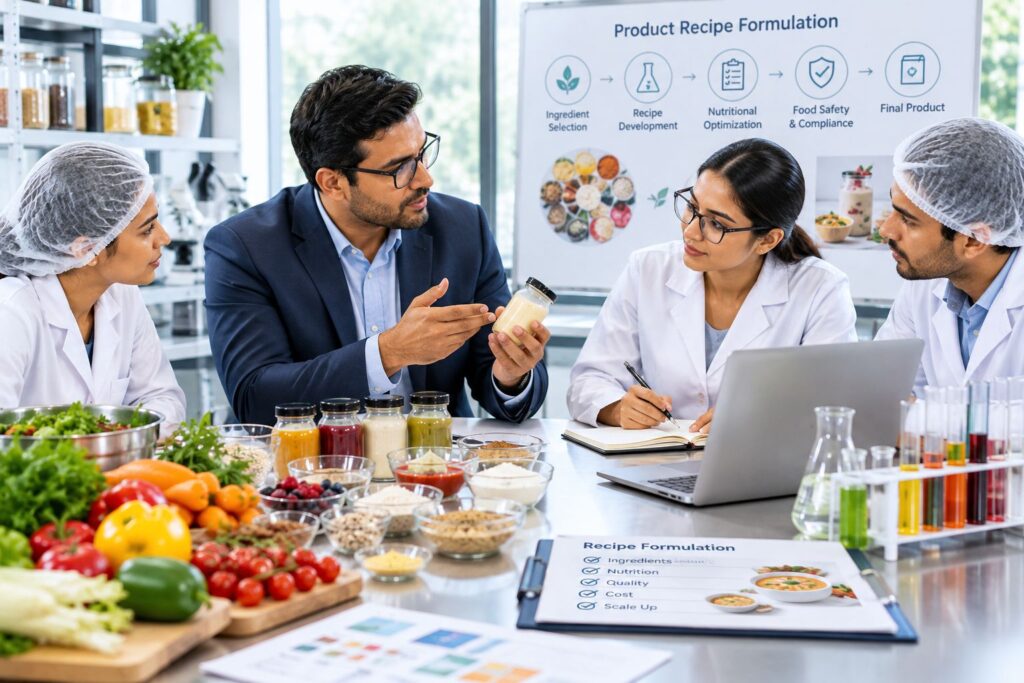
Food consultant and food technologists developing a new food product recipe with ingredients, laboratory testing, and formulation analysis.
FFCE

The Role of a Food Consultant in Product Recipe Formulation

A food consultant significantly contributes to the development of product recipes through food selection, consistency, nutrition optimization, and regulatory compliance. The consultancy helps to innovate novel, safe, and affordable food products satisfying consumer demand in such an intensely competitive industry as food. A distinctive flavour and nutritional value recipe is the key to success in the highly competitive arena of food product development. This is where a food consultant can assist. These professionals bring their expertise in developing recipes that are not only tasty but also cost-effective, scalable, and compliant with food safety regulations. The success of a new food product depends on the brand’s ability to comprehend a food consultant’s role in formulating the recipe. Products developed 0 + Years experience 0 + Countries served 0 + Clients served 0 + Expert Ingredient Selection and Sourcing Making sure you choose the right ingredients is the primary role of a food consultant when developing recipes. This means considering origin, nutritional content, taste, and texture factors. Since they are well-versed in existing food trends, consultants can identify new ingredients that appeal to consumer preferences, such as organic, plant-based, or gluten-free options. They can also advise on alternative ingredients that have the same benefits but are less expensive or have more environmentally friendly possibilities. Developing Consistent and Scalable Recipes Consistency is the most critical aspect of product recipe development. A food consultant helps ensure a recipe performs well in multiple batches. The capability to scale up a product recipe to large-scale production without compromising on quality is paramount once it has been perfected on a small scale. To guarantee that the result is consistent each time it is prepared, consultants utilize their experience to modify the recipe’s ingredient ratios and procedures. Nutritional Optimization and Labeling Today’s consumers care about their health more than ever, so when making a recipe, nutritional optimization becomes essential. A food consultant can adjust the dish to meet specific dietary needs, e.g., reducing sugar, increasing protein, or adding beneficial ingredients like fibre or probiotics. Also, specialists ensure that nutritional labelling is accurate and in line with regulations so your food will be legally saleable. Regulatory Compliance and Safety A food consultant would ensure that your production procedure, from ingredients safety to manufacturing ones, complies with all relevant food safety laws and regulations. All foods must pass regulatory agencies such as the FDA or EFSA in different countries; they must be experts who know the specific rules. They will help ensure that the formulation is safe and suitable for distribution and that your product will comply with all regulations. A food consultant is central to formulating product recipes, from researching ingredients to ensuring regulatory compliance and optimizing nutrition. Their experience ensures that the formula will be safe for mass manufacturing, economical, and meet the customer demand while being unique and market-ready. If you wish to introduce new food merchandise, a food consultant can help you realize your recipe ideas.

Transitioning a food product from kitchen production to commercial factory manufacturing
FFCE

Kitchen Recipe to Factory Setup — Role of a Food Consultant

Expertise in product scaling, recipe standardization, and knowing how to develop an efficient plant layout are critical moves to take an incredibly good food recipe into a viable commercial product. A food consultant, works along with a food technologist to adapt a recipe for commercialization, ensuring replication at mass levels, maintaining its quality and the facility meets the regulations. Their expertise and guidance enable you to move from making food in the home kitchen to having a food brand ready! Introduction It is not an easy task to bring a popular kitchen recipe to a large-scale commercial operation. Even though the original concept may have come from tradition and passion, it takes a methodical approach to turn it into a marketable product. A food consultant can be a very useful partner in this situation. With the assistance of qualified food technologists, food consultants help aspiring business owners at every stage of their food enterprise journey, from product scaling to plant setup and regulatory compliance. Products developed 0 + Years experience 0 + Countries served 0 + Clients served 0 + The First Step: Recipe to Scalable Product Large-scale production is not possible for everything that functions well at home. A recipe designed for five servings may not function the same way when multiplied by five thousand. Product scaling enters the picture here. To keep the original flavors, textures, and appearances of a recipe but adapt it to commercial levels of production, a food consultant works in coordination with a food technologist. It is important to know how the ingredients will act in terms of shelf life, microbial safey, package intent, and cooking methods before product scaling up the best practices. If a recipe called for a spice blend, for example, the spice blend could also need to be reformulated too, if it has an adverse response to industrial heating or preservation methods. The expertise of food technologists allows for this harmony between science and culinary art. Product Standardization & Shelf-Life Testing Standardization is a crucial next step after product scaling. Consistency is the most crucial element in the food industry. All units must be identical in flavor, aroma, and appearance. The food technologist will test for shelf life and stability of the food products and the food consultant will make sure each production of the product conforms to established standards. This scientific testing will guarantee food safety and appeal to the consumer, but it will also help to determine the best packaging material and additives (if required), and storage conditions. Plant Setup Designing the Right Infrastructure A proper plant setup is necessary for the transition from a test kitchen to a commercial kitchen. Plant setup entails figuring out workflow design, utilities, hygienic zones, equipment needs, production capacity, and even employee training. A food consultant assists in creating a layout that facilitates efficient operations, conforms to food safety laws, and permits future growth. The food consultant evaluates 1.Type of food product 2.Required machinery 3.Water and energy needs 4.Waste management system 5.Clean room and contamination control areas. Depending on the type of product, each plant setup has a unique design. For instance, the equipment and layout of a bakery will differ from that of a sauce or beverage processing facility. Compliance and Licensing Support Adhering to legal compliance for food safety and getting licenses such as that given by the FSSAI in India is yet another requirement for plant setup. Food consultants assist clients with documentation, auditing, and certification. A food consultant also determines whether clients’ food and drinks manufacturing plants conform to the required industry standards (like Good Manufacturing Practices (GMP) and Hazard Analysis and Critical Control Points (HACCP)). Production Trials and Commercial Launch Food consultants manage pilot batch trials ahead of commercial production runs. Doing so improves efficiency, provides evaluations for the yield and quality of the production lines, and highlights issues for bottlenecking. Also, this is where we fix anything that isn’t working with the formulations, packaging, and flow of process. Once process validation is complete and the product is prepared for commercial release, the food consultants often provide continuing advice, to help resolve production issues and optimize costs without the sacrifice of quality. Conclusion Scaling a recipe from kitchen to market is much more than just passion, it takes technical knowledge. With the right support with respect to product scaling, formulation and plant set-up, entrepreneurs can ensure consistent quality and meet regulatory compliance. With the help of a food consultant, knowledge of a food technologist, and a thoughtfully constructed facility, entrepreneurs can take a passion and create a viable and sustainable business. Whether your recipe is a contemporary energy bar or your grandmother’s pickle, professional input, and the proper planning present the most opportunities to go from small batch to shelves.

Recipe standardisation process for consistent food product quality and commercial production
FFCE

Why Recipe Standardisation Needs a Professional Food Consultant

Recipe standardization is vital in the process of taking a home-cooked dish to a marketable commodity. It is more than just simply scaling ingredients; it is about the technical changes needed to include multiple controls and monitors for quality and safety. A professional food consultant and a trained food technologist can assist greatly in the recipe standardization process and the scaling space. These professionals help in creating consistency of flavor, texture, and shelf life while changing the recipe to make it practical for large-scale processes. With expert assistance, food entrepreneurs can achieve what they need a reliable and scalable recipe, and it will meet consumer expectations and market regulations. Introduction It is not as simple as multiplying a home-cooked recipe by a quantity for monetary gain in the ever-changing food industry today. This essential step in recipe standardisation will require technical culinary knowledge, food safety knowledge, and knowledge around scaling up a recipe. This is where the expertise of a professional food consultant comes in. Products developed 0 + Years experience 0 + Countries served 0 + Clients served 0 + Understanding Recipe Standardisation Recipe standardisation is the act of writing, testing and refining a recipe so that the final product is consistent in taste, texture, quality and shelf life no matter where or how it is created. This is an important step for new food entrepreneurs and existing brands before moving into commercial production.A recipe standardisation process involves more than trial and error. It requires elements of creativity and science. Professional food consultants, and food technologists in particular, are specifically trained to identify what makes a recipe perform well in a kitchen and transform it into a commercial, scaled, stable product.The Role of Food Consultants in Recipe Development Recipe development goes beyond just cooking; it is developing a product that is reproducible at scale, while also considering the sensory, nutritional, and safety aspects of the creation. Food consultants work with each client too: Fully develop flavour, texture, and colour through technical knowledge.Identify the best ingredients that will perform successfully through batch production.Respond to dietary and market needs (i.e., gluten free, vegan etc.).Ensure adherence to the relevant food safety regulations. Developing a recipe is an exercise in balancing science and art. When you engage the services of a food technologist, he or she will help ensure that you have created something distinctive – a sauce, a chutney or a premium protein snack – and that it has the capacity to be further developed into a repeated (on a larger-scale) product.Scaling Up Without Compromising Quality For any food entrepreneur, scaling a recipe for commercial production is one of the most difficult stages in the development of a product. Recipes that are scaled up, or double or tripled generally do not work because the interaction of ingredients change significantly at larger volume. For example, spices may react differently on a large scale; and the cooking situation is different on an industrial scale compared to the home stove, where heating may vary considerably. This is where a food consultant or food technologist comes in, making the precise changes in formulation and process. They have a good understanding of the equipment capacities, production flows, and ingredient stability that need to be addressed in the context of keeping the taste and quality consistent with the original recipe when the product is being produced at 100’s of kilograms in size. Scaling also has to do with what production method is processed, i.e., bakery, extrusion, cold processing, hot filling, etc. It is important to select the method correctly based on the recipe and the food consultant will work the brand through pilot trials, shelf-life studies and quality control studies, which are normal parts of scaling a recipe for a product.Ensuring Consistency and Shelf Life Consistency is vital in the food industry. Consumers want the same flavour to experience every time they buy your product! Food consultants document steps, like cooking time, temperature, order of mixing, and the cooling process, which are all necessary for consistent batches. Food consultants also evaluate packaging and storage methods that allow for a longer shelf life which is especially critical for startups and D2C food brands shipping product across regions without some sort of compromise to the sensory or nutritional value of the product. Conclusion Whether you are a budding food entrepreneur, or an existing company launching a product line, recipe development and standardisation is a pursuit that cannot be taken lightly. Without proper expertise, even the best recipe in the world can fail in a commercial environment. Partnering with a professional food consultant, particularly one with a food technologist background gives you a scientific knowledge aspect, a regulatory knowledge aspect, and practical industry knowledge. They can not only assist with making your vision a reality, but they will assist with ensuring the product is scalable, safe, and consistent so it can win consumers’ trust and stand up to the competition. Frequently Asked Questions If I scaled my home recipe myself, would it work?You can try scaling your home recipe by yourself, however, if you don’t hire a professional food consultant/ food technologist you risk scaling it improperly and will have variations in taste, texture and shelf life due to scaling the recipe with different ingredient quantities and processing methods. What does a food consultant do to scale a recipe? A food consultant will take your original recipe and modify it for mass production by changing ingredient proportions or cooking method and taking into account any special equipment constraints you’re limited by, and ensure that when your product scales, it will remain consistent and retain the quality of original recipe. What difficulties might come up when scaling a recipe? Changes in ingredient behavior, cooking times, and product stability are typical problems when scaling recipes. To guarantee efficient and dependable production, a food consultant assists in addressing these issues scientifically. Is it possible for a food consultant to assist with both recipe development and scaling on an industrial scale? Definitely. A food consultant pairs

Food consultant helping beverage startups with product development and commercial production
FFCE

Why Beverage Startups Fail Without a Food Consultant’s Support

Numerous beverage startups fail, in part, due to the absence of a food consultant or food technologist on their team. Even if beverage entrepreneurs have a great idea to get started, they are often not equipped to address many key technical components of beverage formulation, as well as legally complying with labeling concerns, shelf-life stability, and a plan for scaling production. A food consultant serves as a helpful startup navigation tool, using their expertise to assist with the many factors of product development, securing legal approvals, packaging, and compliance with cold chain requirements. Without accessing a food consultant, most beverage formulation start-ups suffer common problems such as ingredient instability, labelling mistakes, and challenges with scaling production from test batches to full production. To effectively compete in the beverage startup world, consulting the expert food technologist and a food consultant, and their support can be highly beneficial from the onset. Introduction Starting a beverage company is certainly an exciting and fulfilling experience, but it’s also a very competitive and challenging technical environment. Though the harsh realities won’t always be a shock, entrepreneurs frequently enter the field with a lot of passion and an idea that may include a popular ingredient. From beverage formulation to compliance and scaling and everything in-between, the consequences of neglecting professional assistance can mean avoidable blunders. Food consultants and food technologists are professionals who have a wealth of experiences and resources, and entrepreneurs often overlook hiring one or both in the early days of their beverage startup. One of the top reasons beverage start-ups fail is due to not having a food consultant or a food technologist on their team. Products developed 0 + Years experience 0 + Countries served 0 + Clients served 0 + Understanding the Realities of Beverage Formulation The product is the heart of any beverage business. Whether you are making an herbal drink, protein drink, fruit-based drink, or a carbonated health tonic, beverage formulation is not just about taste. The food technologist will ensure that your beverage product is stable and safe and will last on the shelf for a reasonable amount of time.The food technologist will also consider important factors such as, ingredient interactions, pH levels, preservatives, and emulsifiers – all of which influence prevent problems such as separation of ingredients, microbial growth, changes to the product, and spoilage. Many entrepreneurs do not know who or what a food technologist is, and many think they can create a great formula and figure out the process through trial and error, Youtube tutorials or a home recipe. The reality is that beverages created in a home kitchen simply do not translate into commercial production. This gap between idea and execution is where most startups find problems. The Role of a Food Consultant in Startup Success To transform your beverage concept into a workable, marketable product, a food consultant is essential. They do much more than just technical things of beverage formulation. They serve as your startup manual, providing information on supplier networks, equipment, packaging materials, and regulatory compliance. Here are essential areas in which a food technologist or food consultant adds value to a business: Product Development & Recipe Standardization A consultant ensures your beverage’s taste, color, and texture are the same every time a single batch is made by you. A consultant will also help improve the recipe so that it is the most cost effective and can be made in larger quantities. Regulatory Assistance Food Laws such as FSSAI licensing (for India) requirements for nutrition labeling and nutrition claims are very complicated. A food technologist will help you meet these requirements since many beverage formulation start-ups aren’t able to and as a result often lose products to recalls or incur penalties. Shelf-Life Testing An additional reason why beverages fail is due to shelf-life validation. A food consultant will run a series of microbial and chemical testing to validate the intended use of the product over its intended life. Pilot Trials and Scaling Up Successfully taking a batch, which may be only 1-litre to 1,000 litres in a capacity commercial operation, means that the product may be changed in taste, stability, and yield potential. A food technologist should help you perform pilot trials, make modifications to the production process as necessary for mass production. A Startup Guide to Packaging and Cold Chain Advice Proper packaging and cold chain planning are essential components of a successful beverage startup guide. Without it, goods could lose their flavor, deteriorate, or leak. A food consultant can help select appropriate packaging materials and design a cold chain system suited for temperature-sensitive drinks. Frequent Mistakes When Startups Go Alone Beverage Startups will make expensive mistakes without the support of a professional food consultant: Assuming your manual production is the same for production on a large scale These types of issues will cause your product to fail, result in consumer complaints or force a regulatory body to shut down your product. Why Good Taste is Not Enough? Although good taste is important, Great beverage startups do not just innovate the product with flavour. The beverage must be scientifically designed, legal matters addressed, and technically reproducible. A food technologist will help ensure that your vision ticks every box. Not even premium packaging or best-practice marketing pays off when a product is poorly formulated or unstable. A single bad batch may destroy your brand reputation forever. Conclusion For any entrepreneur that is entering into the beverage space, food consultation is not an option – it is a requirement. They have the knowledge for beverage formulation, regulatory aspects, and scaling up production so they’d be more able to wholly develop a creative idea into a full-blown brand, allowing you to commercialize it effectively. Essentially, a food technologist allows you to be the startup. It also saves you costly mistakes that obscured beverage entrepreneurs have made before you and allows for faster access to a market.If you care about launching a beverage that is unique and sustains interest in a heavily loaded

HACCP and FSSAI food safety certification process with a food consultant
FFCE

How to Get HACCP & FSSAI Certification – With Help from a Food Consultant

+Getting HACCP and FSSAI certification is important for food companies to achieve food compliance and food safety standards in India. A food consultant or food technologist can make this easier by providing you with the guidance you require for documentation, audits and system execution. They also know whether your food business activities meet national and international regulations. Introduction The two important pre-requisites certifications to legally operate a food business in India are: FSSAI (Food Safety and Standards Authority of India) & HACCP (Hazard Analysis Critical Control Points) certifications. Both certificates protect food safety and develop consumer confidence and make your business exports ready. However, it is not a simple task to get certified. There are food compliance protocols to adhere to, documentation process to consider and inspections to undergo. A food consultant or food technologist will be your best friend in this situation. With their technical experience, commercial knowledge and their understanding of the compliance environment, they can help guide your certification process and reduce the potential for delays that may end up being costly. Products developed 0 + Years experience 0 + Countries served 0 + Clients served 0 + What is FSSAI Certification? FSSAI is India’s top regulatory body for regulating food enterprises and enforcing food safety standards, mandatory for food enterprises to manufacture, process, pack, distribute, and sell. Any food enterprise irrespective of their food items is mandatory to have an FSSAI license. There are three types of FSSAI licenses based on the size of business:  • Basic Registration – for small food businesses (turnover < 12 lakh/year)  • State License – for medium-sized businesses (turnover 12 lakh – 20 crore)  • Central License – for large-sized businesses, and for export/import businesses. To obtain an FSSAI license, food businesses must complete the following steps: -Register their business -Complete Form B -Provide the layout of the premises and plan for equipment -Provide a list of food products -Provide a plan for a food safety management system -Provide a declaration and affidavits. A food consultant can assist you in gathering and preparing the documentation and can also identify the appropriate ‘category’ of registrations or licenses and submit the documents with no errors. What is HACCP Certification? Hazard Analysis Critical Control Point (HACCP) is a food safety management system that is recognized internationally, where hazards are identified and evaluated, and controlled. HACCP systems are not a legal requirement in India for all businesses, but ideally, HACCP is for businesses that want: -Maintain greater levels of food safety -Enhance their export opportunities -Comply to global standards (in particular European, USA, and Gulf standards). The steps involved with HACCP are: -Hazard analysis -Identifying critical control points (CCP) -Establish monitoring procedures -Maintain documentation and verification systems A food technologist has been trained to deal with the technical aspects of HACCP and are able to visit your facility, assess the facility, help you implement preventative measures, train your staff, and prepare a SOP’s and manuals to suit your operations. Why Work with a Food Consultant? Here’s how a food consultant or food technologist can ease your certification process: 1. Gap Analysis They will conduct an audit of your current systems to identify any deficiencies that would need to be addressed to be HACCP or FSSAI compliant. 2. Customized Documentation The food consultant will prepare customized documentation, including hazard plans and SOPs, that are tailored to your business processes while allowing for compliance. 3. Support with Implementation Not only will they support you in implementing necessary changes to your infrastructure but also meaningful hygiene practices, staff training, and sanitation practices essential for sustaining certification. 4. Preparing for Audit Your food consultant will prepare your team and assist you with preparing for both internal and external audits to ensure you have minimized opportunities of non-conformance. 5. Compliance Support Post-certification Food consultants can support with your annual renewals, upgrades, and continuous improvements of your food compliance standard. Conclusion Whether you are starting a new food business or scaling your existing food business, achieving food safety through HACCP and FSSAI certification should not be an option but a requirement. Using a food consultant or food technologist with experience in compliance will provide you with a time-efficient and less stressful way to make sure you achieve food compliance from day one. Investing in support is not just about achieving legislation compliance – it is about ensuring the food compliance of your brand, protecting your customers, and ultimately your future in food. Frequently Asked Questions Why do I need help of food consultant for both FSSAI and HACCP certification?A food consultant helps you understand complex regulatory requirements, prepare appropriate documentation and they will provide steps for an audit, all to have complete food compliance to achieve a smooth and quick certification. How does a food technologist make a difference in helping me achieve food safety standards?A food technologist uses their scientific and technical expertise to improve hygiene, identify hazards and implement the necessary food safety procedures (as needed for HACCP and FSSAI compliance obligated). Is HACCP obligatory for food businesses in India? HACCP is inconsistent for all businesses under Indian law, as it is not obligatory, but many businesses involved in exports, large manufacturers and businesses wanting to demonstrate advanced food safety systems have access directly to HACCP standards recommended. What is the full process for obtaining FSSAI certification?After you select the right licensing type, you will: Fill out the documents: i.e. Form B, layout of the facility, list of products or food types, plan for food safety management, after this fill out all obligations for food compliance inspection.

Need Help?
Scroll to Top

Your Trusted Food-Tech Partner Simplifying Solutions, Maximising Success

    Your idea is 100% protected by our Non Disclosure Agreement

    Your Trusted Food-Tech Partner Simplifying Solutions, Maximising Success

      Your idea is 100% protected by our Non Disclosure Agreement

      Your Trusted Food-Tech Partner Simplifying Solutions, Maximising Success

        Your idea is 100% protected by our Non Disclosure Agreement

        Powering your food business forward