FFCE

Now Hiring: Are you a driven and motivated 1st Line Food Technologist?

food factory setup

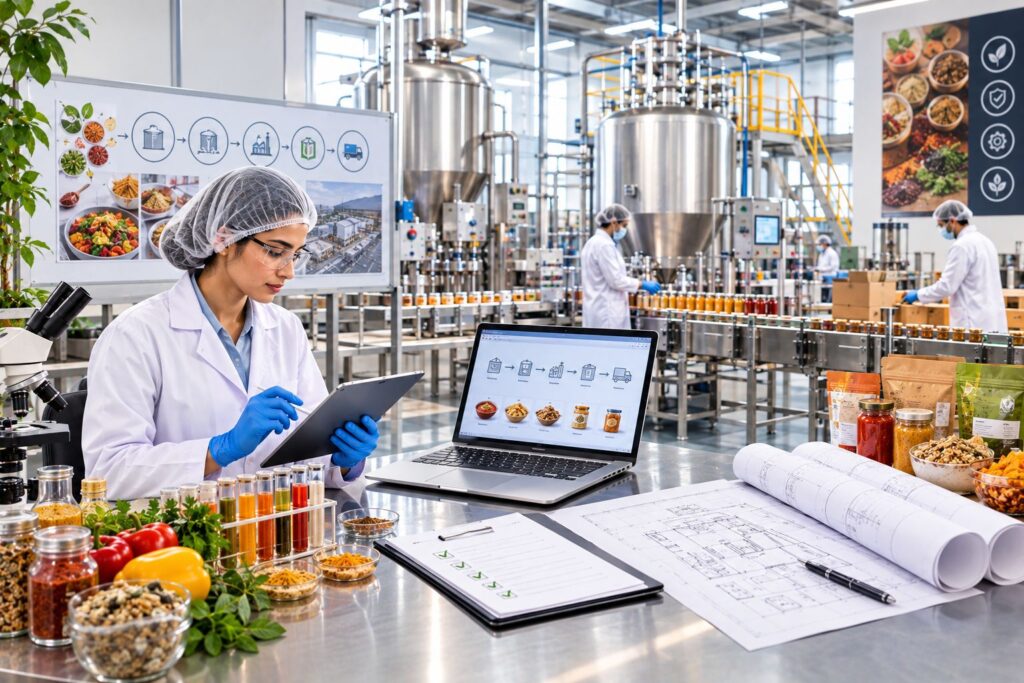
Food technologist overseeing turnkey food factory setup and production planning
FFCE

The Role of a Food Technologist in Turnkey Food Factory Setup Projects

The work of a food technologist is significantly crucial in turnkey food factory build, supporting each phase from product development, equipment selection, quality control and regulatory compliance. The food technologist would usually operate individually or with a food consultant to streamline the entire food factory build process ensuring it is compliant, operational, and sustainable. Introduction The process of establishing a food factory from the ground up is a much layered, complex project which requires knowledge in multiple areas. One of the most important contributors to the successful planning of turnkey food factory projects is a Food Technologist. As the food and beverage industry quickly changes in response to consumer demand, health fads, and regulations, Food Technologists have become vital to driving innovation and ensuring compliance in food manufacturing environments. Products developed 0 + Years experience 0 + Countries served 0 + Clients served 0 + What Is a Turnkey Food Factory Setup? A turnkey project is a facility that is equipped and ready to operate, given to the client in accordance with the contract. In the food industry, it takes the project from inception (planning and design) to selection of machinery, installation of machinery, product development, packaging, quality control systems and regulatory compliance. Those in the food industry prefer a turnkey solution just to minimize the hassle of dealing with multiple vendors and going through a variety of accountability points.   The food technologist is very important here, as they facilitate the transformation of ideas (from raw concepts) into reality. The Critical Role of a Food Technologist Food technologists have the scientific and technical expertise to ensure the result of a facility operates properly and produces safe, quality outcomes. The activity of a food technologist can cover the complete life cycle of a turnkey project from start to finish. 1. Product and Process Development Before any factory can be built, it is important to understand what the products being produced will be. A food technologist assists a food company in developing the recipes, formulations, and processing parameters to ensure that at any scale from lab testing to pilot plant to production scale – the processes produce consistent taste, texture, shelf-life, and nutrition. 2. Equipment and Layout Planning Selecting suitable equipment is critical to achieve a stable output and sustainable efficiency. A food consultant who has a background in food technology will work with you to ensure the machinery you select is suitable for the characteristics of your food product, and for food hygiene purposes. They will impact the layout of the factory to accommodate the food production workflow while remembering the requirements for food safety, for example, to minimize the risk of contamination and whether it meets HACCP or FSSC 22000 standards. 3. Regulatory Approval Food topic adds many stakeholders involved in food production operations. Food technologists navigate stringent local and international regulations while ensuring all aspects comply with food laws, including all inputs, processes, labelling and packaging. When establishing the plant, a technologist will engage all regulators as well as help obtain all certifications and licenses needed for the operation of the plant. 4.Quality control and safety systems Creating and establishing quality control systems is another way in which food technologists add value. They will provide SOPs, CCPs and testing regimes to follow to make certain each product is consistent and meets specifications. Their experience means that food safety risks are recognised and controlled from day one. 5.Staff training and SOP Once the factory is ‘up and running’, all staff need to be trained to abide by food safety practices and operate the equipment properly. A food technologist aids in developing the contracted SOPs and trains the operators, supervisors and the quality control staff to ensure production standards are met and to avoid issues such as cross-contamination, spoilage and/or incorrect operation of equipment. 6.Research and innovation A turnkey project goes beyond simply setting up a factory. Markets change, and food technologists remain involved for research and development of new products, packaging, and process work. This ensures that the factory is relevant and responsive to changes in the marketplace. Working with a Food Consultant Often, food businesses will hire a food consultant with turnkey experience designing multiple factory setup projects. This individual usually comes with a “team”, including food technologists, engineers, and incorporation/safety regulatory experience to follow through with end-to-end execution. These experienced food consultants have had “real work” experience about avoiding mistakes, delays and non-compliance. Finding the right consultant or in-house food technologist early in the planning process could mostly save time and money and set the stage for long term success. Conclusion In the assignment of turnkey food factory setups, the food technologist is both at a strategic level and at a hands-on level throughout the process. They are responsible for the initial product development, machine selection, quality assurance and regulatory compliance, etc. They will help make sure the product, the machine, and the process are scientifically sound and commercially viable. Regardless of whether they are working alone or as part of a broader food consultant team, food technologists are really the engine behind successful food manufacturing businesses. A good food technologist will not only help you get your factory launched more quickly, but they will also help you be sustainable and compliant in the long term.

Low-cost food factory setup with efficient processing equipment and production layout
FFCE

Low-Cost Factory Setup Options for First-Time Food Entrepreneurs

For the food factory setup, new food entrepreneurs can save money by selecting flexible options like turnkey projects, modular units, third party manufacturing, or shared kitchens. A food consultant guarantees that your setup is production-ready, scalable, and compliant. Starting a food business becomes more feasible and cost-effective with the correct professional and plan. Products developed 0 + Years experience 0 + Countries served 0 + Clients served 0 + Introduction First-time food entrepreneurs may find the high costs and regulations of setting up a food factory daunting. On the other hand, affordable choices like turnkey projects and shared kitchens provide useful answers. A food consultant can streamline the entire food factory setup with the correct approach. Affordability, scalability, and compliance are guaranteed by professional advice. 1. Implement a Scalable Plan Start small within an active facility can easily exhaust most of your finances. Rather, plan it as an expansion venture that is able to start small but increase through time. A food consultant can work with you to determine your current production needs, market, and future growth as well as recommend space and layout design options as well as equipment that are space-saving. This way you’re building a risk-adverse model as you are keeping lean while being flexible in your setup. 2. Work from a Shared Kitchen or Incubator One of the most inexpensive food factory setups is starting in communal commercial kitchens or food incubator facilities. They provide easily available infrastructure, minimum machinery, and regulatory compliance perfect for initial production and market testing. With the help of a food consultant, owners can streamline processes and remain in compliance. It does away with the necessity for massive capital outlays but is a stepping point toward larger configurations or turnkey projects in the future. 3. Investigate Turnkey Projects If you are ready to have your own facility but do not want to manage construction and installation logistics, turnkey projects can be a great option. In a turnkey project, a service provider will construct and set up the facility, from the design of the food factory to installing heavy machinery, utility enclosures, and doing trial runs with the facility when it is handed off to you. For a first time food entrepreneur, a turnkey project can provide you with a timely, compliant, and efficient solution to set up your food facility. 4. Choose Modular Units and Pre-fabricated Structures Rather than building a traditional brick-and-mortar factory, think about a prefabricated unit or modular units. They are much less expensive, quicker, and you can play with layouts and set them up to easily relocate them. A food consultant can help you with sourcing vendors for a modular kitchen set up related to your category, such as snacks or beverages, or ready to eat meals. 5. Buy Used or Compact Equipment Choose well-maintained secondhand or small multifunctional equipment for a cost-effective factory setup instead of costly new machinery. These are excellent for initial stage scaling and smallbatch manufacturing. Particularly while designing forthcoming turnkey projects, a knowledgeable food consultant can help you find reliable suppliers and make certain the equipment fits your production objectives. 6. Take advantage of Government Subsidies and Schemes India has several schemes which aim to promote food processing and small manufacturing units such as PMFME (Pradhan Mantri Formalisation of Micro food processing Enterprises) as well as schemes from food parks at the state government level that may help. A good food consultant can find and access specific subsidy options that will provide a much-needed financial cushion as you set up your factory. 7. Comply from Day One Not complying early can add costs later. Compliance includes set up of the factory layout, source of water, packaging line, storage, etc., compliant to applicable FSSAI norms. A food consultant will provide vital support on ensuring your facility is on regulatory compliance, which will in turn keep fines from taking away food business profits and ensure compliance for future audits and exports. Conclusion For creating a low-cost and capital-efficient food factory setup, budding food entrepreneurs can adopt the above steps. Be it selecting a shared kitchen, modular unit, or turnkey project in full format, all three are a good beginning depending on budget and capacity. Having a professional food consultant as a business partner guarantees your infrastructure is compliant, economical, and future-friendly. By prioritizing planning and expert advice, you can send your food item out without risking economic stability with the space for further growth. Frequently Asked Questions 1. What is the initial set up for factories that is the cheapest for someone just getting started? For someone getting started, shared kitchens or small modular units will be the cheapest way of starting because they require a relatively low investment. The shared kitchen or modular unit can later be developed into a full turnkey project with the assistance of a consultant specialized in food. 2. How does a food consultant help with the setting up of a food factory? A food consultant will help you with all steps including the right location, equipment purchasing, FSSAI requirements and compliance, layout design. This will help ensure you minimize mistakes, avoid wasting lots of money, save time and ensure that the food factory will be efficient and legally compliant. 3. What are turnkey projects in the food manufacturing space? Turnkey projects are ready to work spaces with the professional team managing everything from the design/development, and installation along with applicable compliance requirements so the person is ready to have an operational food factory setup with a very low investment of time. 4. Are turnkey projects good for small food businesses? Yes, turnkey projects are an excellent choice for small or first time food business setting up and running a professional food business. Usually the food consultant is involved with co-ordination of these turnkey projects as they are familiar with the constructor and supplier processes.

Food plant setup consultant planning a food manufacturing facility with production equipment
FFCE

Food Plant Setup Consultant Guide: Planning, Equipment Selection & Compliance

Food plant setup basically is an overall design of a manufacturing unit and includes several stages such as product identification for manufacture, feasibility study, design and economic appraisal, material procurement, installation of plant and commissioning. The design encompasses technical aspects, number of unit operations, market outlook, economic conditions etc. The primary role of a food plant setup consultant is to analyze the specific requirements of clients and develop a customized layout that offers operational efficiency. The first step to follow before establishing a food processing plant is to conduct in-depth market research. Identifying the current market trends in the industry, preferences of consumers and competitors in the field will provide insights into market dynamics. This is followed by developing a business plan. The business structure must be first established – sole proprietorship/partnership/private company etc. and then the business name must be registered with the Registrar of Companies. Choosing an appropriate location for plant construction is a vital step and this decision is dependent upon the proximity of the plant to raw material suppliers, accessibility to stock, distribution of the end product and labor availability. The regulatory requirements such as obtaining import export code, FSSAI (Food Safety and Standards Authority of India) license for food safety standards, GST registration for tax compliance, trade license for operating legally in the municipality, fire safety certificate and pollution control NOC (no objection certificate) for abiding by the fire safety regulations and meeting environmental laws of emissions, waste and pollution are required before setting up a food manufacturing business. The next step is to craft a business plan that includes enumerating the objectives of company, strategies for the operation and marketing of the enterprise, amount of capital required for the plant establishment, estimation of profit, revenues and cashflows, calculating the cost of labor, production, raw materials and overhead expenses. A written business plan indicating the financial requirements and available funding from investors and other financial institutions must be documented. Securing funding and acquiring licenses will enable the construction of manufacturing plant with provisions made for machinery, packaging material and storage facilities. There are stark differences between the food and non-food processing plants and these stem from their production methods. As the shelf life of foods is minimal and the quality is strongly influenced by several factors like pH, temperature, microbial contamination, water activity etc., product safety is of prime importance. Therefore, food plants are designed to offer high sanitation levels to prevent the possibility of contamination and product deterioration. Implementing quality control measures is an important in upholding consumer trust. Establishing hazard analysis and critical control points (HACCP) and standard operating procedures (SOPs) for processes will educate the staff on best practices and regulatory changes in the industry. Expanding business internationally will provide access to a larger consumer base, drive innovation and enable market diversification. It is therefore necessary to develop a marketing plan for product advertisements through online platforms, social media, and engaging in trade shows. Adhering to these steps and seeking assistance from a food consultant will help in overcoming the challenges related to a plant setup and achieving business goals.  

Need Help?
Scroll to Top

Your Trusted Food-Tech Partner Simplifying Solutions, Maximising Success

    Your idea is 100% protected by our Non Disclosure Agreement

    What is Refresh icon

    Your Trusted Food-Tech Partner Simplifying Solutions, Maximising Success

      Your idea is 100% protected by our Non Disclosure Agreement

      What is Refresh icon

      Your Trusted Food-Tech Partner Simplifying Solutions, Maximising Success

        Your idea is 100% protected by our Non Disclosure Agreement

        What is Refresh icon

        Powering your food business forward