FFCE

Now Hiring: Are you a driven and motivated 1st Line Food Technologist?

instant noodles India

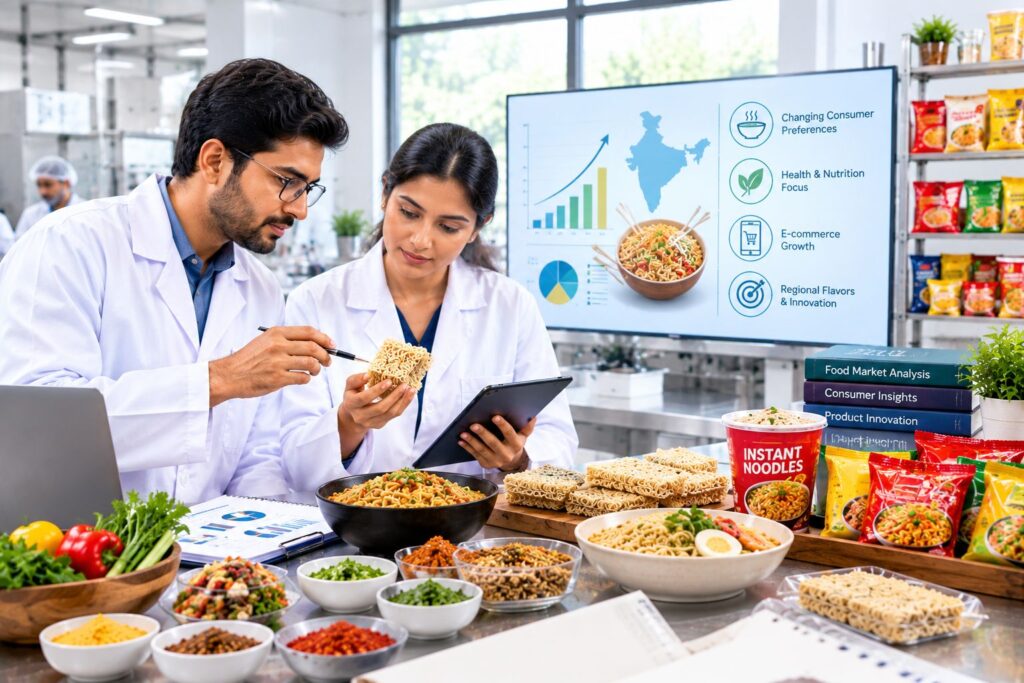
Food technologists and product developers evaluating innovative instant noodle products, including millet noodles, high-protein noodles, and premium instant meal solutions in India.
FFCE

The Evolution of the Instant Noodle Market in India: Insights for Food Consultants

The instant noodle market in India has evolved from a one-brand segment to an industry being driven by innovation, PAN Asian flavours, health trends and consumer diversity. For food consultants it demonstrates the need to adapt to changing dynamics in tastes, regulations, and digital retail strategies, and the consumer appetite for nutritious and convenient options leaves this category open for more strategic growth and product development. Introduction The instant noodle business in India has changed a lot in 40 years and provides key insights for food consultants, product developers, and F&B strategists. Beginning as a category created by just one brand, the instant noodle market has evolved into a competitive landscape focused on product development and innovation. The journey across product development reflects an evolving tela of consumer behaviors, urbanism, and health awareness. Products developed 0 + Years experience 0 + Countries served 0 + Clients served 0 + Pioneering Phase: Maggi’s Market Creation Instant noodles entered the Indian market, when Nestle launched Maggi 2-Minute Noodles, in 1983. The product filled a distinct consumer need in the Indian kitchen – a tasty meal that was quick, inexpensive, and didn’t need much preparation. Maggi was not only a new product but made a generation of consumers aware of convenience food. To sell their product, Maggi used kids and busy parents as their marketing strategy to develop brand equity that driven strong emotional connection. Diversification and Competitive Growth In the late 1990s, additional brands entered the market Top Ramen, Wai Wai and Sunfeast Yippee offering regional flavors, differences in texture, and different styles of cooking (such as Wai Wai’s precooked noodles). As food consultants noted, this enabled a segmenting substitution for noodles, which was formed on dimensions of price; taste; and demographics. Noodles were no longer merely a snack; they now formed part of mainstream meal planning, especially for urban and college-based consumers. Crisis as Catalyst: The 2015 Maggi Ban The provisional ban of Maggi in 2015 was a watershed moment because of concerns about whether the product was safe for consumption. This shook consumer confidence in premade noodles in India, but it opened space for new regional players in the market and improved regulatory scrutiny. For agricultural food consultants, this period provided an emphasis on transparency, traceability and compliance in product formulation and labeling. Current Trends: Health and Innovation Drive Growth At present, the Indian instant noodle market is going through some changes towards being more health conscious. There are brands with millet-based, whole grain, gluten-free, and protein-fortified noodles to create variants that fit into changing diets. In addition, premium variants of instant noodles are increasingly identifying with gourmet flavors, organic ingredients, and sustainable packaging, largely in metro towns and with Gen Z. The growth of D2C (direct-to-consumer) food startups has found some ways to improve access/availability for nutritionally relevant products with e-commerce distribution. Conclusion: Strategic Opportunities for Growth For food consultants, the trajectory of instant noodles in India is a prime example of consumer trend progression, innovation pathways and market dynamics. The segment has displayed resilience and adaptability among Indian consumers because of its convenience, price point, and now the health angle. As Indian consumers continue to search for variety, value and nourishment, the instant noodle category figures to continue to be a fertile ground for product innovation, thoughtful branding and regional customization. India is future equipped for noodle consumption beyond instant, Instant noodles as nutrition intelligently reimagined.

Instant noodles products representing the growing instant noodles market in India
FFCE

Instant Noodles Market in India

In India, instant noodles represent one of the most popular ready-to-cook (RTC) products, combining convenience, affordability and taste. Instant Noodles in India have come a long way since their entry into the market in the 1980’s, moving from masala noodles to a greater variety of flavors, health focused and premium gourmet segments. Furthermore, with the increasing consumer trend of demand for quick meals, the instant noodles market will likely continue to expand in the future, especially with the growing young demographic in India. This blog introduces some of the technical aspects of instant noodle manufacturing, new flavor trends and potential for new businesses in the instant noodle sector. Products developed 0 + Years experience 0 + Countries served 0 + Clients served 0 + The Manufacturing Process of Instant Noodles  In order to provide a consistent product, the highly standardized method of making instant noodles integrates formulation science, food engineering, and packaging technology.  Among the fundamental steps are: Making the dough and blending the flour A flour source is the primary component; blended/grain flours, buckwheat flour, millet flour, and rice flour are increasingly used. A supply of flour is combined with water (30–35%) and useful additions like: Use alkaline salts (kansui: sodium/potassium carbonate) for texture and flexibility. Guar gum and CMC are examples of hydrocolloids that improve mouthfeel and water retention. Protein fortification (whey protein, soy protein) – for high protein noodle curls. To achieve consistent gluten formation, the dough is mixed at a controlled amount of shear. Sheeting and Slitting Dough is sheeted to 0.8–1.2 mm thickness using rollers. Successive laminations align gluten strands for elasticity. Sheets are slit into strands (1–1.5 mm wide) using cutters. Steaming The noodle strands are cooked in steam for approximately three minutes at a temperature of 100 degrees celsius. This process then facilitates the noodle cooking process during final preparation of the ready to cook variants. It pre-gelatinises the starches, which facilitates rehydration. Frying / Non-Frying Drying Methods Fried noodles – strands are fried in palm oil at 140–160 degrees Celsius for 60–120 seconds, which decreases moisture level to ~3–5% while forming a porous structure for improved rehydration. Air dried or baked noodles, these are available for health conscious consumers, but you really need good control on drying to rehydrate to the same level. Preparing the Seasoning Spices, hydrolyzed vegetable proteins, yeast extracts, dried veggies, or freeze-dried meats are included in the majority of sachets. You will typically find emulsified flavor oils provided separately to amp up the aroma. Packaging Packaging films have been engineered to provide oxygen and moisture. They can provide an oxygen and moisture barrier for a longer shelf life (6-12 months generally). Nitrogen flushing was used initially to protect against the fat in fried noodles from oxidizing. Technical Challenges and Pain Points While instant noodles exist in numerous developed and developing regions, manufacturers are faced with several challenges: Quality of Oil in Frying: The stability of palm oil and the risk for oxidation affects the shelf life of the instant noodles and the stability of the flavor. Work is looking into blending with rice bran or sunflower oil. Health Concerns: Elevated sodium levels and fried formats cause regulators and consumers to be more cautious. There is significant work on reformulation with salt replacers (potassium chloride) and using non-frying methods. Fortification: Because heat processing may affect sensitive vitamins stability, fortification studies using micronutrients include iron, zinc not to mention vitamin A, must be developed when fortifying instant noodles. Flavor Consistency: When testing sensory testing following key taste qualities including traditional Indian flavours (masala, curry, and biryani), it is important to find a good balance with selective non-Indian consumers. Sustainability: Producers are adopting the recyclable films and environmentally friendly pressure acts from consumer agencies. New Flavors and Product Innovations The Indian instant noodles space has expanded beyond just “masala” noodles. The companies which operate in this category are innovating rapidly in product form and flavor: There are different noodles with regional flavors, such as Bengali mustard, Punjabi tadka, Kashmiri yakhni, sambar, and others. Glocal Flavors: there are noodles inspired by Italian pesto noodles, Japanese miso, Thai tom yum, and Korean hot ramen. Multigrain( quinoa, oats, millet) all healthy alternatives to noodles.  Dairy and pulse proteins are added to high-protein noodles. Low fat, baked, or air-dried formats. Whole freeze-dried vegetable pieces, dehydrated paneer, soy protein, or chicken chunks for a gourmet look are examples of premium add-ons. For the health-conscious young urban consumer, nutritionally fortified noodles include those that contain plant proteins, probiotics (encapsulated), or prebiotic fiber (inulin). Entry Points for New Food Businesses The instant noodle market in India has several entry points: Regionalization: Products based on local food traditions (e.g., pindi chole noodles, dhokla flavors). Health and Wellness: Noodles could be positioned to urban millennials and Gen Z as un-fried, fortified, or millet-based products. Premium Imports: With demand for Korean ramen and Japanese udon increasing Indian consumers might appreciate Indian based equivalents at an accessible price point. Sustainability Angle: Sustainable packaging, clean-label seasoning restaurant alternatives, and palm oil. Function of Food Consultants like FFCE Starting an instant noodles business requires expertise across R&D, engineering, regulations and supply chains. Food consultants like Frontline Food Consultants and Engineers (FFCE) are able to assist companies in the following: Product Development: Custom formulation for health, regional, or premium instant noodles. Process Selection: Selection of extrusion-cooking line, fryer and dryer technologies. Fortification: Fortified noodles that meet FSSAI standard. Conduct Sensory and Shelf-life studies: Consistency of flavor, texture, or microbiological safety throughout shelf life. Machinery – and plant development: Whole-line support of sourcing, layout development, and installation of noodle lines. Regulatory: Recognize codex, FSSAI, and export regulations for foreign markets. Conclusion The instant noodle market in India has changed from being a single-flavor, single-format product to a broad category that now includes premium, regional, and health varieties.  Both current and new competitors in the market have opportunities because to the creative advancements in processing, flavoring, and packaging technologies as well as the rising customer acceptance of convenient, healthful meals.  Businesses may overcome technological and regulatory obstacles to succeed in this cutthroat but developing

Need Help?
Scroll to Top

Your Trusted Food-Tech Partner Simplifying Solutions, Maximising Success

    Your idea is 100% protected by our Non Disclosure Agreement

    What is Refresh icon

    Your Trusted Food-Tech Partner Simplifying Solutions, Maximising Success

      Your idea is 100% protected by our Non Disclosure Agreement

      What is Refresh icon

      Your Trusted Food-Tech Partner Simplifying Solutions, Maximising Success

        Your idea is 100% protected by our Non Disclosure Agreement

        What is Refresh icon

        Powering your food business forward